Tips for Metabolism and Understanding Hormones
FAT BURNING HORMONES
HGH (human growth hormone): a building and burning hormone that works with cortisol and adrenaline to ensure fat is burned rather than stored.
Thyroid Hormone: Strongly impacts energy levels and is one of the major ways that body raises your metabolic thermostat. The connection between thyroid hormone and leptin may be most responsible for metabolic compensation. An increase in stress from life, from cutting calories, or from cutting carbs too much has a negative impact on thyroid hormone production.
HUNGER HORMONES
Ghrelin and Leptin: Ghrelin regulates hunger hour to hour while leptin is day to day. Ghrelin is linked to cravings. As ghrelin rises after a long day with no eating, hunger signals are sent to the brain. High ghrelin signals are hard to overcome with just willpower. Eating protein and fiber along with intense exercise can curb ghrelin’s hunger message.
Leptin is like the fuel gauge in the body. It tells your brain how much fat you have. If your brain loses the ability to hear leptins message (usually from severe dieting) you will keep eating as though you are starving. Leptin also regulates thyroid function. Too low or too high levels cause metabolic compensations. This is why extreme low calorie and no or very low carb diets backfire in the long run. One of the reasons people are morbidly obese is a loss of leptin’s messaging the brain right.
Insulin: Insulin has two sides. It’s a fat storing hormone on one side. High insulin often means extra calories are more likely to be stored as fat. Insulin also inhibits fat release so you are less likely to burn fat in a low calorie state. So insulin often makes fat cells greedier or more stubborn. The other side of insulin is its ability to build muscle and control hunger. With the right timing and planning insulin can be used to achieve a toned lean body. The trick with insulin is to maintain the right amount (not too much not too little). Of course all processed carbs trigger insulin release faster but there are ways around this.
STRESS HORMONES
Cortisol: also a two sided hormone. It can either help or hinder fat loss. Think of this as an emergency hormone. It’s released anytime the body perceives a threat, whether it’s emotional stress, food allergies, intense exercise, or missing a meal. Cortisol released with adrenaline, HGH, and testosterone like during exercise becomes a positive and enhances fat burning. But when cortisol is released in presence of high insulin, low testosterone, and limited HGH, as in the standard American lifestyle it becomes a fat storing, muscle burning hormone. The key here is also balance.
Adrenaline: it signals the body to begin burning fuel during exercise and when present with cortisol, testosterone, and HGH but when it’s released in someone who has high insulin and leptin levels but isn’t exercising, it causes cravings and leads to muscle loss as well.
REPRODUCTIVE HORMONES
Estrogen and Progesterone: These two greatly impact hunger, energy, and cravings. Estrogen and Progesterone impact brain chemicals GABA, serotonin, and dopamine. This is the reason cravings go crazy during a woman’s cycle. Estrogen and progesterone levels fall and cause brain changes that lead to moodiness, hunger, and cravings.
Estrogen tends to keep women thinner overall but leads to more fat storage in the hips, butt, and thighs. So it’s a fat burning and fat storing hormone. It also makes it easier for females to tolerate stress and better shape muscle.
Progesterone more women more likely to store fat and more likely to lose muscle because it opposes estrogen. However it does work with estrogen to block cortisol leading to the desirable hour glass shape of females.
A NOTE: the two weeks leading up to the female cycle estrogen is lower. This is a time to manage eating and stress more and not be all about high intensity workouts and go go go. The two weeks after the start of the female cycle estrogen is higher. This is when its best to exercise more and eat more but many females try to avoid exercise during this time. The opposite would benefit fat loss.
Testosterone: Has effects in multiple areas of body. It helps build and shape muscle but in females higher amounts compared to estrogen and progesterone thicken the waist and lead to more of an apple shape. This is why women who are impacted by stress a lot, have PCOS, or are menopausal gain more belly fat so it also a matter of balance here.
DIFFERENCE BETWEEN HUNGER AND CRAVINGS
Hunger is felt in the gut. It’s an empty, gnawing feeling. Cravings are felt in the head as a feeling of desire. So when you’re eating out of boredom, that’s not hunger – it’s a craving coming from your brain. Cravings arise from brain chemistry and habits. Cravings are linked to stress as cortisol rises under stress but when you reward yourself with something in stressful situations you create a negative habit loop. I understand everyone doesn’t want to track hormones and may not want all this info but here’s what to do. If you are having cravings, think stress and try to reduce it but if you are having true hunger that would be where you add snacks to your day to keep your HEC in balance. More on HEC (Hunger, Energy, and Cravings) below.
We had a separate post about this in the past but a great way to understand if you are on the right path is to keep track of your HEC (hunger, energy, and cravings).
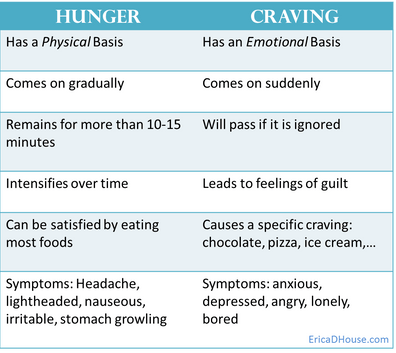
Here’s a recap from that blog:
Hunger: If hunger is an issue focus on eating more protein, fiber, and water rich foods. To control behavioral based hunger increase your water intake in between meals and start increasing water dense food with negligible calories like celery, lettuce, peppers, and cucumbers.
Energy: If you are having low energy or swings in energy, first make sure you aren't trying to Exercise More while severely cutting calories. Make sure you are eating enough protein and that you are not cutting carbohydrates or fats too fast or low. Also try adding snacks in between meals if you aren't doing this already. If this raises your energy, then its most likely a blood sugar issue. Try to avoid hitting caffeine and energy based drinks too often throughout the day.
Cravings: If you are experiencing cravings it most likely due to an increase in stress! Focus on more relaxing and rest based activities such as massage, walking, yoga, stretching, watching funny movies, affection and most important of all SLEEP!
Hope that was helpful! Until next time....If you're struggling with your fitness program, want to get back in shape or need help with eating habits click here to schedule a free consultation!
Regards,
Ray C.
Owner - NASM, CPT,CES, CFL1
You might also like